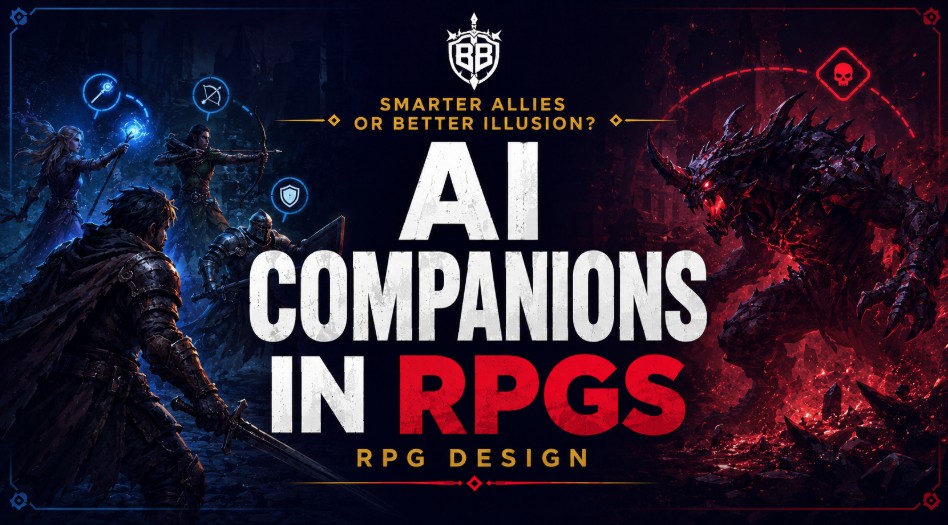
AI Companions in RPGs: Why Good Party Members Feel Human Without Being Smart
AI companions in RPGs rarely need to be perfect. In fact, companions that occasionally make believable mistakes often feel more alive than ones that play flawlessly. Great companion design isn’t about building an unbeatable AI—it’s about creating allies that players understand, trust, and naturally work alongside.
Whether you’re exploring dangerous ruins, surviving a horror adventure, or commanding a fantasy party, companion AI quietly shapes almost every combat encounter. When it works well, players barely notice it. When it fails, it becomes impossible to ignore.
Quick Answer: What Makes AI Companions Good?
Good AI companions prioritize readability over perfection. Players should quickly understand why an ally healed, attacked, defended, or retreated. Predictable behavior creates trust, while consistent roles make teamwork feel natural.
| Design Goal | Player Benefit |
|---|---|
| Clear Priorities | Players understand ally decisions. |
| Role Consistency | Each companion has a reliable identity. |
| Limited Autonomy | Players still feel in control. |
| Readable Feedback | Actions make sense during combat. |
Why Perfect AI Isn’t Always Better
Imagine a healer who always chooses the mathematically optimal spell. While technically impressive, that behavior can actually reduce player involvement. If companions solve every problem automatically, players begin watching combat instead of participating in it.
The strongest RPGs usually strike a balance. Companions are competent enough to feel dependable, but not so perfect that they replace player decision-making.
Companions Should Express Personality Through Gameplay
Dialogue builds character, but gameplay reinforces it. A cautious knight who protects weaker allies, a reckless rogue who aggressively targets vulnerable enemies, or a disciplined mage who conserves mana all communicate personality through mechanics.
When behavior matches characterization, companions feel believable even without advanced artificial intelligence.
Common Mistakes in Companion AI
- Healing at full health.
- Ignoring obvious threats.
- Walking into hazards repeatedly.
- Using powerful abilities at the wrong time.
- Changing behavior unpredictably between battles.
Most of these problems aren’t caused by intelligence—they’re caused by unclear priorities.
Simple Rules Often Beat Complex Systems
Many memorable companion systems rely on surprisingly straightforward decision trees:
- Protect allies below a health threshold.
- Target enemies threatening the party.
- Preserve resources for stronger encounters.
- Support the player’s current objective.
Clear rules are easier to tune, easier for players to learn, and often produce more satisfying teamwork than highly unpredictable behavior.
The Broken Build Perspective
For indie developers, companion AI should focus on reinforcing player strategy rather than replacing it. Every ally should answer a simple question: “How does this character make the player’s choices more interesting?”
Instead of chasing complex machine-like intelligence, build companions whose decisions support the game’s pacing, combat flow, and narrative identity. A reliable healer, an aggressive frontliner, or a tactical support character can create memorable teamwork with surprisingly simple logic.
Common Misconception
Players don’t necessarily want smarter companions—they want companions they can understand and trust.
FAQ
What are AI companions in RPGs?
They are party members controlled by the game’s artificial intelligence that assist the player during exploration, combat, or story events.
Why do some RPG companions feel smarter than others?
Usually because their priorities are clear and consistent, allowing players to predict and cooperate with their actions.
Should players be able to customize companion AI?
Many RPGs benefit from offering basic behavior settings such as aggressive, defensive, support, or balanced. This gives players strategic control without requiring direct micromanagement.
Can simple AI create memorable companions?
Absolutely. Strong personality, clear combat roles, and reliable decision-making often matter far more than technically advanced AI systems.
Why Players Remember Great Party Members
Players rarely remember how many calculations their companions performed behind the scenes. They remember the healer who saved the party at the last second, the warrior who blocked a devastating attack, or the rogue who finished an enemy just in time.
Those moments aren’t created by perfect intelligence. They’re created by thoughtful design, consistent behavior, and companions that make the player feel like they’re fighting alongside real teammates instead of scripted NPCs.