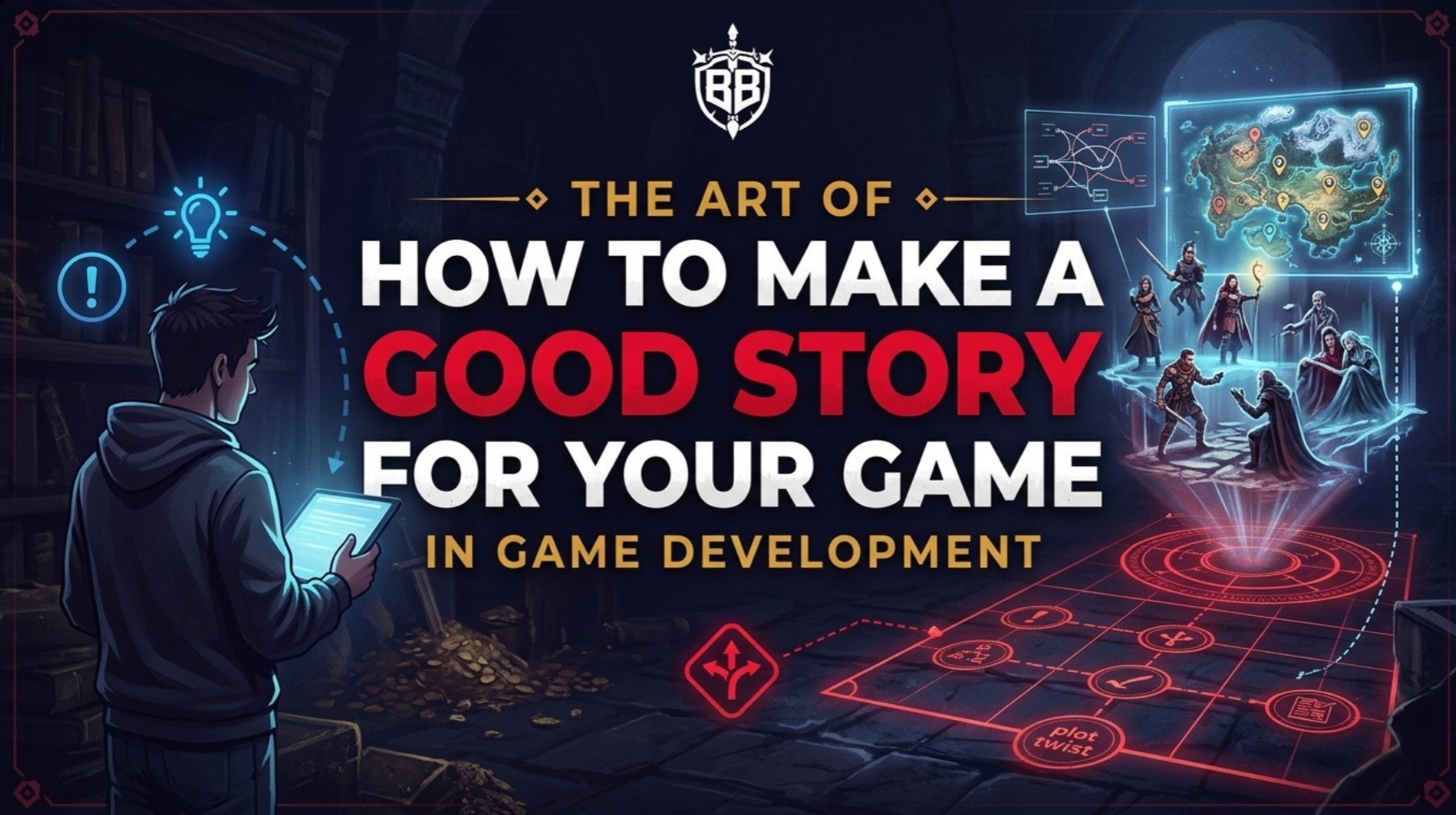
How to Write a Game Story That Players Can Actually Experience
Learning how to write a game story begins with one important distinction: a video game narrative is not simply a movie script interrupted by combat. It is a story communicated through player actions, objectives, environments, systems, dialogue, consequences, and discovery.
A strong game story gives the player a meaningful reason to move forward. It explains what they want, what stands in their way, what could be lost, and how their actions affect the world. The narrative and the gameplay do not need to communicate the same information, but they should feel as though they belong to the same experience.
Affiliate disclosure: this article contains affiliate links. If you buy through them, Broken Build Games may earn a small commission at no extra cost to you.
What Does It Mean to Write a Game Story?
Writing a game story means designing a narrative that can survive contact with the player. Unlike a novel, a game cannot always control where the audience looks, how quickly they move, which optional conversations they hear, or which approach they use to solve a problem.
The writer therefore creates more than a sequence of scenes. The work may include:
- A central premise and dramatic conflict
- Character arcs and relationships
- Worldbuilding rules
- Main missions and optional quests
- Dialogue trees and contextual lines
- Environmental storytelling
- Player choices and consequences
- Descriptions for items, locations, abilities, and objectives
- Story beats connected to progression
- Alternative outcomes for failure, success, or exploration
The finished narrative must work even when the player behaves differently from what the writer imagined. That is what makes game writing both difficult and creatively rewarding.
A game story is not only what happens to the protagonist. It is what the player understands, feels, and changes while interacting with the game.
Start With the Player Experience, Not the Lore
Many new writers begin by creating kingdoms, historical eras, political factions, invented languages, and timelines stretching across thousands of years. Worldbuilding can be useful, but it should not be the first problem you solve.
Start by defining what the player will repeatedly do and how that activity should feel.
For example:
- If the player explores abandoned locations, the story might focus on investigation, memory, uncertainty, or recovery.
- If the player manages a struggling settlement, the narrative might explore responsibility, scarcity, leadership, or compromise.
- If the player repeatedly hunts powerful creatures, the story should explain why the hunts matter and what each victory changes.
- If the game is built around stealth, the protagonist’s vulnerability, secrecy, or social position should support that behavior.
This approach prevents a common disconnect in which the cutscenes describe one kind of character while the gameplay encourages completely different behavior.
Define the Narrative Promise
The narrative promise is the emotional and dramatic experience your game offers. It is more useful than a long plot summary because it helps every creative decision point in the same direction.
A narrative promise might be:
- Survive a collapsing space station while deciding who can be trusted.
- Rebuild a ruined community and live with the compromises required to protect it.
- Track a missing sibling through a city that changes according to the protagonist’s memories.
- Lead a group of rivals who must cooperate against a threat none of them fully understands.
A useful narrative promise contains a situation, an emotional pressure, and a role for the player. It tells the development team what kind of experience they are building without locking every scene into place too early.
Build the Story Around Three Core Questions
Before writing chapters or dialogue, answer three questions about the playable character.
1. What Does the Character Want?
The protagonist needs a visible objective that can create missions. They may want to escape, find someone, repair something, expose a conspiracy, protect a community, gain recognition, or recover a lost ability.
The objective should be concrete enough to guide the player, even when the character’s deeper emotional need is more complicated.
2. What Prevents Them From Getting It?
Conflict is not limited to a villain. It can come from the environment, limited resources, rival goals, social rules, personal fear, incomplete knowledge, or the consequences of an earlier decision.
In games, good obstacles create both drama and interaction. A locked door is more meaningful when opening it requires the player to choose between two costly solutions.
3. What Must Change?
The external objective gives the player direction. The internal change gives the journey meaning.
The protagonist may need to trust others, accept responsibility, question a belief, stop pursuing revenge, understand their own history, or recognize the damage caused by their methods. That change can be fixed, partially influenced by the player, or divided across several endings.
Create Four Narrative Pillars
Narrative pillars are short principles that help writers, quest designers, level designers, artists, and programmers evaluate ideas. They are especially useful when a project grows and different team members begin creating content.
| Pillar | Question It Answers | Example |
|---|---|---|
| Theme | What idea is the story exploring? | Trust must be earned through action. |
| Player role | Who is the player within this world? | A mediator between hostile settlements. |
| Core tension | What makes every major decision difficult? | Helping one faction weakens another. |
| Tone | How should the experience consistently feel? | Melancholic, tense, but never hopeless. |
These pillars should be specific enough to reject ideas. If almost any quest, character, joke, or location fits your pillars, they are too broad to guide the project.
Choose the Right Narrative Structure
Not every game needs branching dialogue or multiple endings. The structure should match the development scope, available technology, gameplay loop, and amount of content the team can realistically produce.
| Structure | How It Works | Main Challenge |
|---|---|---|
| Linear | The player experiences major events in a controlled order. | Maintaining player involvement without major story choices. |
| Branching | Decisions change scenes, relationships, quests, or endings. | Controlling production costs and avoiding meaningless choices. |
| Hub-based | The player chooses the order of several storylines before returning to a central path. | Writing scenes that still make sense in different orders. |
| Environmental | The player reconstructs events through locations, objects, behavior, and optional clues. | Making important information discoverable without overexplaining it. |
| Systemic or emergent | Rules and interacting systems produce stories that were not fully scripted. | Giving unpredictable events enough context to feel meaningful. |
A focused linear story is usually stronger than a branching structure filled with choices that barely affect the experience. Player agency can come from combat strategy, exploration, resource management, character relationships, or mission order—not only from dialogue options.
How to Write a Game Story Step by Step
Step 1: Write the Story Premise in One Sentence
Describe the protagonist, their objective, the main obstacle, and the unusual element that makes the concept worth exploring.
Example: A courier who can hear the memories stored inside lost objects must cross a flooded city to discover why its remaining citizens are forgetting each other.
The sentence does not need to explain every twist. Its purpose is to reveal the playable situation.
Step 2: Define the Beginning, Turning Point, and Ending
Before planning dozens of missions, identify three structural anchors:
- Beginning: What disrupts the protagonist’s normal life and gives the player a goal?
- Turning point: What discovery, failure, or decision changes how the player understands that goal?
- Ending: What final action proves how the character or world has changed?
These anchors create direction while leaving room for levels, quests, encounters, and character moments to evolve during development.
Step 3: Build a Beat Sheet
A beat sheet lists the major narrative events in order. Each beat should change at least one important condition: the player gains information, loses an ally, reaches a new location, acquires an ability, creates an enemy, or must reconsider the objective.
A simple beat sheet might include:
- The protagonist accepts the mission.
- The first objective reveals that the official explanation is incomplete.
- An ally introduces a competing interpretation of the crisis.
- The player reaches a location that contradicts both accounts.
- A major failure changes the available routes or resources.
- The player discovers how their earlier actions contributed to the conflict.
- The final mission forces them to act on what they have learned.
Avoid filling the beat sheet with information alone. A revelation matters more when it changes what the player must do.
Step 4: Convert Story Beats Into Playable Objectives
For every major story event, ask what the player is doing while it happens.
Instead of writing “the protagonist learns that the village is being watched,” the mission might ask the player to identify hidden observation points, follow a suspicious signal, protect a witness, or decide whether to disable the surveillance system.
This conversion turns exposition into experience.
Step 5: Test the Story Against the Core Gameplay Loop
Write down the actions the player performs most often. Then ask whether the narrative supports those actions.
If the story describes the protagonist as a reluctant negotiator but most missions reward aggressive destruction, the character concept and gameplay loop may be working against each other. The answer is not always to remove combat. The narrative might instead acknowledge the contradiction, restrict certain actions, change the rewards, or make the consequences visible.
Write Characters Who Create Gameplay Problems
A useful game character does more than deliver dialogue or explain the setting. They create objectives, complications, emotional stakes, information gaps, mechanical opportunities, or difficult decisions.
For every important character, define:
- What they want from the protagonist
- What they refuse to admit
- What useful ability, resource, or knowledge they possess
- What makes cooperation difficult
- What event could change their relationship with the player
- How their behavior appears during gameplay rather than only in dialogue
A medic who distrusts the protagonist might charge more for supplies, refuse certain upgrades, provide incomplete information, or become more cooperative after the player protects civilians. Their characterization becomes part of the system instead of remaining confined to cutscenes.
Give the Player Agency Without Losing Control of the Story
Player agency means that the player’s actions feel meaningful. It does not require an unlimited number of choices or completely different campaigns.
Agency can affect several layers:
- Tactical agency: how the player approaches an encounter
- Exploration agency: which locations or clues they discover
- Relational agency: which characters trust or oppose them
- Strategic agency: which resources, factions, or regions they prioritize
- Interpretive agency: how much of the story they understand
- Dramatic agency: which major outcome they create
A project can use one or two of these layers effectively without building a massive branching narrative. What matters is that the game communicates the result of the player’s decisions.
Make Worldbuilding Serve the Game
Worldbuilding becomes valuable when it explains what the player sees, what they can do, why systems exist, and why different groups behave as they do.
Instead of writing a long history first, define the rules that affect the present experience:
- What does this society value?
- Who controls important resources?
- What behavior is forbidden or rewarded?
- What technology, magic, or natural rule changes everyday life?
- What conflict is visible in the architecture, clothing, equipment, or level design?
- What does the player understand immediately, and what must be discovered?
When a city depends on a rare energy source, that fact should affect its security, economy, enemies, architecture, transportation, political power, and mission design. A world feels coherent when the same rule produces several visible consequences.
How to Write Dialogue for a Game
Game dialogue often needs to communicate information while the player is moving, fighting, exploring, or making decisions. That means clarity and timing matter as much as style.
Give Every Line a Function
A line might reveal character, explain an objective, signal danger, provide feedback, establish tone, create tension, or change a relationship. Strong lines frequently perform two functions at once.
Avoid Repeating What the Player Can Already See
If the player has entered a burning building, a companion does not need to announce that the building is on fire. The dialogue can instead reveal urgency, blame, fear, or a new problem that is not visually obvious.
Write for Interruption and Repetition
Players may trigger combat, move away from a speaker, reload a checkpoint, or hear the same contextual line several times. Dialogue should remain understandable when interrupted and tolerable when repeated.
Separate Character Voice From Information
Two characters can communicate the same objective differently. One may describe a route through military landmarks, another through local shops, and another through emotional memories. Voice appears in what a character notices and values, not only in accent or vocabulary.
Turn Side Quests Into Small Stories
A side quest should reveal something about the world, test a theme, develop a relationship, complicate a system, or give the player a different perspective on the main conflict.
A practical side-quest structure is:
- Request: Someone asks the player to solve a visible problem.
- Complication: The situation is different from how it was described.
- Choice or test: The player must apply a skill, sacrifice a resource, or choose between priorities.
- Consequence: The world or a relationship changes in a noticeable way.
Even a short quest becomes more memorable when its ending changes how the player understands the initial request.
Control Narrative Pacing Through Play
Narrative pacing is not only the distance between cutscenes. It is the rhythm created by challenge, discovery, conversation, travel, danger, recovery, and decision-making.
After an intense boss encounter, the player may need a quieter area in which to process the result, explore environmental details, speak with allies, or prepare for the next objective. Placing another major revelation immediately after the fight may cause the information to be ignored.
A useful pacing pattern alternates:
- Questions and answers
- Pressure and relief
- Action and reflection
- Familiar mechanics and new complications
- Player control and authored presentation
The exact rhythm depends on the genre. A horror game may preserve uncertainty longer, while a tactical RPG may use conversations between battles to reinterpret earlier decisions.
What New Game Writers Often Get Wrong
Writing the Entire Story Before Testing the Game
Mechanics, level scope, production limits, and technical systems will change during development. A story written as an untouchable screenplay may become expensive or impossible to implement.
Write enough to establish direction, then revise alongside prototypes.
Explaining the World Before Creating a Reason to Care
Players are more likely to remember history and terminology after those details affect a character, objective, location, or decision. Context should arrive when it becomes useful.
Treating Every Choice as a Different Ending
Small choices can alter dialogue, access, resources, relationships, visual details, or later mission conditions. Meaningful consequences do not always require completely separate finales.
Using Cutscenes to Repair Unclear Gameplay
A cutscene cannot always fix a mechanical experience that communicates the opposite idea. When the player’s actions and the story disagree, examine objectives, rewards, enemy behavior, failure states, and progression—not only the dialogue.
Adding Lore That Never Affects Anything
Background information can enrich a setting, but a large collection of names and dates does not automatically produce depth. Prioritize details that change the way players understand a location, faction, mechanic, or character.
The Common Misunderstanding About Game Scripts
A game script is often imagined as one large document containing every scene and line of dialogue. In practice, narrative information may be divided across several documents and tools.
| Document | Purpose |
|---|---|
| Narrative overview | Explains the premise, themes, characters, tone, structure, and major conflicts. |
| Beat sheet | Lists the major story changes in sequence. |
| Mission or quest brief | Connects objectives, locations, characters, mechanics, and outcomes. |
| Dialogue script | Contains spoken lines, conditions, responses, and implementation notes. |
| Narrative flowchart | Shows branches, conditions, variables, and reconnection points. |
| World reference | Records terminology, locations, factions, rules, and continuity details. |
The exact format matters less than clarity. Every team member should be able to understand what triggers a narrative moment, what the player knows, what can change, and what content is required.
A Simple Example of Story and Gameplay Working Together
Imagine a game about a cartographer mapping an unstable underground city.
Premise: The protagonist must map safe routes before the city’s structures shift again.
Gameplay loop: Explore, place markers, manage light, record hazards, return with information, and unlock safer routes.
Narrative conflict: Different communities want the maps altered to protect their own territory or conceal dangerous secrets.
Player agency: The player decides which routes become public, private, or deliberately incomplete.
Character arc: The protagonist begins by believing maps are neutral records and gradually discovers that controlling information is a form of power.
The concept works because the central theme is expressed through the player’s main action. Mapping is not a side activity attached to the plot; it is how the player participates in the conflict.
Broken Build Perspective: Design the Story as a System of Meaning
The most effective game narratives do not depend on a single dramatic twist. They create a consistent relationship between what the story says, what the world shows, and what the player repeatedly does.
If a game explores sacrifice, its systems should occasionally make the player give something up. If it explores trust, information and cooperation should carry risk. If it explores isolation, the absence or presence of other characters should affect more than the dialogue.
This does not mean every mechanic needs a symbolic explanation. It means the game’s most important actions should reinforce its emotional identity rather than accidentally weakening it.
A useful test is to remove the cutscenes from your concept and ask what story the remaining actions would suggest. Then remove the gameplay description and ask what kind of actions the written story promises. The closer those answers are, the more unified the experience is likely to feel.
Game Story Planning Checklist
- Can the premise be explained in one clear sentence?
- Does the protagonist have a playable objective?
- Is the central conflict visible through gameplay?
- Do important characters create decisions or complications?
- Does each major story beat change the player’s situation?
- Is the scope appropriate for the team and production schedule?
- Are choices followed by understandable consequences?
- Does worldbuilding affect locations, mechanics, or behavior?
- Can important information survive interruption or missed dialogue?
- Do side quests contribute to the world, characters, or themes?
- Does the final challenge test what the protagonist has learned?
- Can the story be revised when prototypes reveal a better direction?
FAQ
Do I need to finish the entire story before developing the game?
No. You should establish the premise, characters, major beats, ending direction, and narrative requirements, but the story should remain flexible enough to respond to prototypes, level changes, and production limits.
What is the difference between a game story and a game script?
The story is the complete narrative experience, including characters, conflict, worldbuilding, actions, and consequences. The script is one implementation document containing scenes, dialogue, conditions, or other narrative content.
Does every game need a complex story?
No. A game needs enough context to make its actions, goals, tone, and progression understandable. A simple story that supports the gameplay is often more effective than a complex narrative disconnected from the player’s experience.
How can I make player choices feel meaningful?
Show the consequences through relationships, resources, locations, mission conditions, dialogue, or access to information. The result does not always need to be a completely different ending, but it should be visible and understandable.
Should gameplay or story come first?
They should develop in conversation with each other. Early prototypes reveal which actions are enjoyable, while narrative goals explain why those actions matter. Treating either side as permanently fixed too early can create unnecessary conflicts.
Why a Playable Story Feels Different
A game story becomes memorable when the player does not merely witness its central idea but participates in it. The player crosses the dangerous route, spends the limited resource, trusts the uncertain ally, discovers the hidden evidence, or accepts the consequence of a difficult choice.
Begin with a clear playable role. Build conflict around the actions your game can support. Write characters who complicate those actions, worldbuilding that explains them, and consequences that make them feel significant.
The goal is not to place the largest possible story inside a game. It is to create a story that becomes stronger because it can be played.
If you are developing your first narrative project and want a practical resource beside you, you can check the recommended game-writing resource here.