RPG Status Effects: How Small Conditions Create Big Combat Decisions
RPG status effects are temporary conditions that change how a character fights, survives, moves, or makes decisions. Poison, stun, burn, silence, sleep, freeze, haste, slow, shield, and weakness are not just “extra effects.” When designed well, they turn combat from simple damage trading into tactical problem-solving.
The best status systems make players ask better questions: Should I cure this now? Can I risk one more turn? Is this enemy dangerous because of raw damage, or because it controls the flow of battle?
Quick Answer: What Are RPG Status Effects?
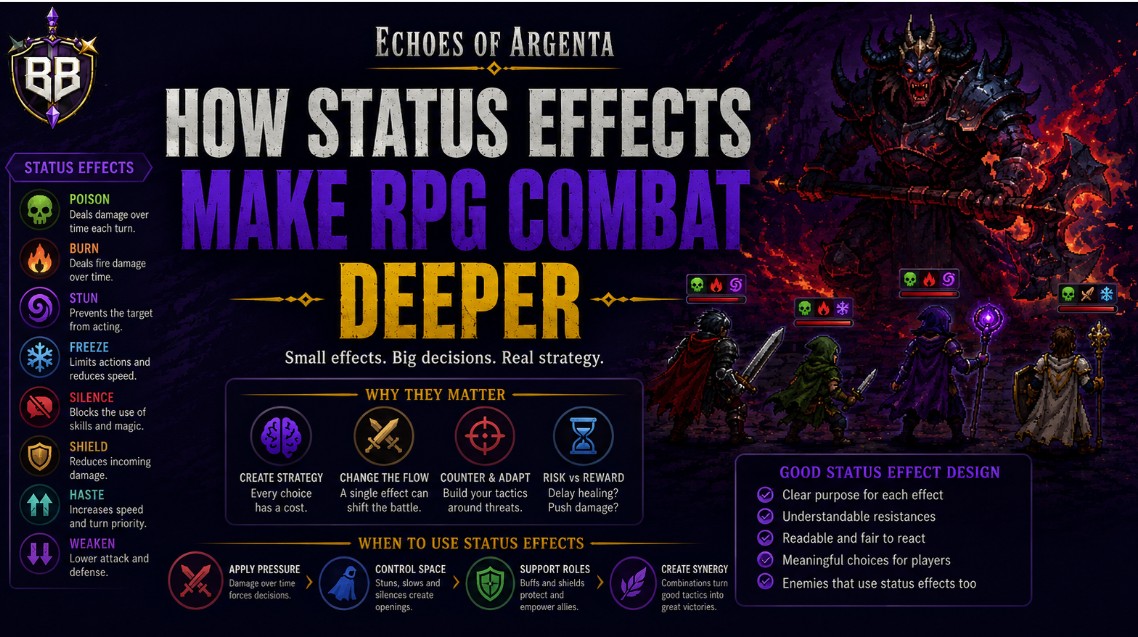
RPG status effects are buffs, debuffs, conditions, or temporary combat states that modify what a character can do. They can reduce stats, block actions, add damage over time, change turn order, force positioning choices, or create combo opportunities.
| Status Type | Example | Combat Purpose |
|---|---|---|
| Damage Over Time | Poison, burn, bleed | Creates pressure over several turns |
| Control | Stun, sleep, freeze | Limits actions and changes priorities |
| Stat Change | Attack down, defense up, haste | Shifts advantage without ending the fight |
| Ability Restriction | Silence, blind, bind | Targets specific roles or strategies |
Why RPG Status Effects Matter More Than Raw Damage
Damage answers one question: how fast does the enemy’s health disappear?
Status effects ask several questions at once. Can the healer still act? Is the tank losing defense? Is the mage silenced before a major spell? Is poison worth curing, or is the battle almost over?
That is where depth appears. A strong status effect does not simply punish the player. It creates a meaningful decision.
Good RPG Status Effects Create Tension, Not Annoyance
A bad status effect feels like the game took control away for no interesting reason. A good one creates pressure while still leaving the player with options.
- Poison works when the player can choose between curing, rushing damage, or defending.
- Silence works when party roles matter and magic is powerful enough to miss.
- Stun works best when it is short, readable, and avoidable through planning.
- Weakness works when enemies can exploit it, but players can counterplay it.
The Biggest Mistake: Status Effects That Never Matter
Many RPGs include long lists of conditions, but only a few are worth using. If bosses are immune to everything and normal enemies die too quickly, status effects become decorative.
A status effect should either change a decision, open a strategy, or reveal something about the enemy. If it does none of those things, it is probably noise.
How to Design Better RPG Status Effects
- Give each effect a clear purpose. Do not add poison, burn, and bleed if they all do the exact same thing.
- Make resistances understandable. Players should learn why a fire creature resists burn or why an armored enemy ignores bleed.
- Avoid total shutdown too often. Losing control is frustrating when it happens repeatedly.
- Let bosses interact with status effects. Full immunity is easy, but partial resistance is usually more interesting.
- Use enemies to teach the system. A weak monster can introduce poison before a boss weaponizes it.
RPG Status Effects and Enemy Identity
Status effects are also storytelling tools. A swamp creature that poisons the party communicates danger differently from a knight who lowers defense or a ghost that silences magic.
The effect tells the player what the enemy represents mechanically:
- A spider teaches caution and cleansing.
- A necromancer teaches resource pressure.
- A shield-bearing soldier teaches armor breaking.
- A frost mage teaches turn delay and positioning.
This is where combat design and worldbuilding overlap. The player understands the creature through what it does, not only through dialogue or visual design.
The Broken Build Perspective
For indie RPGs, RPG status effects are one of the most efficient ways to create depth without producing dozens of new animations or enemy models.
A single enemy can feel completely different if it poisons, marks, slows, counters, or weakens the player. The trick is restraint. Three well-designed conditions can create more memorable combat than twelve vague ones.
The strongest systems make status effects readable, thematic, and worth using outside basic encounters.
FAQ: RPG Status Effects
What is the best status effect in RPG combat?
There is no universal best. Poison is great for pressure, stun is strong for control, and haste is excellent for tempo. The best effect is the one that creates a meaningful choice in your combat system.
Should bosses be immune to status effects?
Not always. Full immunity can make player builds feel useless. Partial resistance, shorter duration, or reduced effect strength usually creates better design.
How many status effects should an indie RPG have?
Start small. Five to eight clear effects are often better than twenty similar ones. Each condition should have a purpose, counterplay, and visual feedback.
Are buffs considered status effects?
Yes. Buffs like haste, shield, regeneration, and attack up are positive status effects. They matter because they change player priorities and combat rhythm.
Why This Idea Still Feels Different
RPG status effects work because they make combat feel unstable in a controlled way. They interrupt autopilot. They force adaptation.
A battle without status effects often becomes a race between health bars. A battle with smart conditions becomes a conversation between systems: pressure, risk, recovery, timing, and counterplay.
That is why status design still matters. It gives every enemy a chance to be more than a damage number.