Turn-Based vs Real-Time RPG Combat: Which System Fits Your Game?
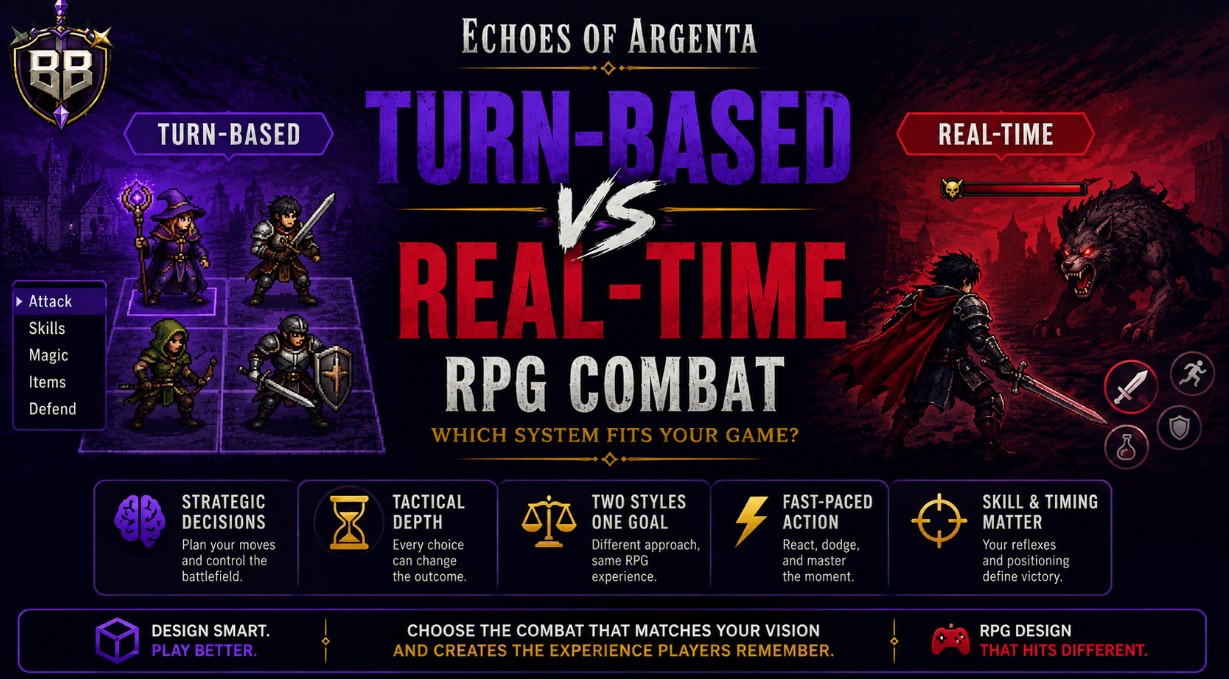
The debate around turn-based vs real-time RPG combat is not really about which system is “better.” It is about what kind of pressure, strategy, readability, and emotional rhythm your game wants the player to feel.
Turn-based combat gives players time to think. Real-time combat asks them to react. Both can be deep, stylish, tense, and memorable, but they create that feeling through completely different design tools.
Quick Answer: Turn-Based vs Real-Time RPG Combat
Turn-based RPG combat works best when the game wants tactical planning, party synergy, resource management, and readable decision-making. Real-time RPG combat works best when the game wants movement, reflexes, positioning, timing, and physical tension.
| Combat Style | Best For | Main Risk |
|---|---|---|
| Turn-Based | Strategy, party roles, readable systems | Can feel slow if choices are obvious |
| Real-Time | Action, movement, timing, immersion | Can become chaotic or hard to read |
| Hybrid | Tension plus tactical control | Can confuse players if rules are unclear |
Why Turn-Based RPG Combat Still Works
Turn-based combat creates drama through choice. The player studies the battlefield, checks resources, predicts enemy behavior, and commits to a plan.
That pause is not a weakness. It is the core fantasy. The player becomes a commander, strategist, or party leader rather than only a fast-handed fighter.
This is why turn-based RPGs often shine when they include:
- Elemental weaknesses and resistances
- Party formations
- Status effects
- Cooldowns or limited resources
- Enemy patterns that reward observation
- Risky but powerful abilities
A good turn-based battle asks: “What is the smartest decision right now?”
Why Real-Time RPG Combat Feels More Immediate
Real-time combat creates pressure through movement. The player does not just choose actions; they execute them under stress.
Positioning, dodge timing, animation commitment, spacing, and enemy telegraphs become part of the RPG system. Stats still matter, but the player’s hands matter too.
Real-time RPG combat is especially effective when the game wants:
- Fast exploration-to-combat transitions
- Physical weapon impact
- Enemy attacks that can be avoided manually
- Boss fights built around movement patterns
- A stronger sense of danger in the environment
A good real-time battle asks: “Can you read the moment and act correctly?”
The Hidden Design Question: Who Is the Player Supposed to Be?
The combat system defines the player’s role. Not the story role, but the physical and mental role.
| Player Fantasy | Better Fit |
|---|---|
| A tactician managing a party | Turn-Based |
| A swordsman reacting under pressure | Real-Time |
| A commander pausing time to plan | Hybrid |
| A party leader balancing chaos and control | Real-Time with pause or tactical commands |
Common Misconception: Turn-Based Means Outdated
Turn-based combat is not outdated. Boring turn-based combat is outdated. The difference is whether each turn creates a meaningful choice.
A turn-based RPG feels weak when the best move is obvious every round. Attack, heal, repeat. That is not a turn-based problem; that is a decision design problem.
Strong turn-based systems make the player weigh damage, survival, positioning, tempo, resource cost, and future risk.
Common Misconception: Real-Time Means Less Strategic
Real-time combat can be extremely strategic, but the strategy happens faster and often through muscle memory.
Choosing when to attack, when to retreat, when to spend stamina, when to interrupt, and when to save resources can be just as thoughtful as selecting commands from a menu.
The challenge is clarity. If the screen becomes too noisy, players stop reading strategy and start guessing.
Turn-Based vs Real-Time RPG Combat for Indie Developers
For indie teams, the choice is not only creative. It is also about production scope.
Turn-Based Combat Production Tradeoffs
- Requires fewer complex movement animations.
- Allows deeper enemy logic without frame-perfect execution.
- Needs strong UI, readable feedback, and balanced encounters.
- Can support larger parties more easily.
Real-Time Combat Production Tradeoffs
- Requires more animation polish.
- Needs reliable hit detection and responsive controls.
- Demands clearer enemy telegraphs.
- Can become expensive if every weapon needs unique movesets.
A small team can absolutely build either style, but each one spends its budget in different places.
A Practical Checklist Before Choosing
- How many party members does the player control?
- Does the game reward planning or reaction more?
- How much animation can the team realistically produce?
- Will enemies be readable at gameplay distance?
- Does the camera support precise action?
- Can the UI explain the system without slowing the game down?
- What should a normal battle feel like after ten hours?
The Broken Build Perspective
For Broken Build, the most interesting RPG combat systems are not the ones with the longest feature list. They are the ones where every mechanic supports the fantasy of the game.
A story about fragile survivors in a dangerous world may benefit from slower, harsher turns where every item matters. A story about a trained warrior fighting through unstable terrain may feel better with real-time movement and reactive defense.
The mistake is choosing a combat system because it looks popular. The stronger question is: what kind of decision should the player remember?
FAQ: Turn-Based vs Real-Time RPG Combat
Is turn-based combat easier to make than real-time combat?
Usually, turn-based combat is easier to prototype because it does not require the same level of animation timing, collision precision, and input responsiveness. However, balancing a deep turn-based system is still difficult.
Is real-time combat better for modern RPGs?
Not automatically. Real-time combat can feel more immediate, but turn-based combat can offer clearer strategy and stronger party management. The better choice depends on the game’s goals.
Can an RPG mix turn-based and real-time combat?
Yes. Hybrid systems can work well when they clearly explain timing, commands, cooldowns, and player control. The danger is making the player feel unsure whether they should think tactically or react physically.
Which combat system is better for party-based RPGs?
Turn-based combat usually makes party control easier to understand, especially when each character has unique roles. Real-time party systems need strong AI, clear commands, or pause mechanics to avoid frustration.
What should beginner indie developers choose?
Beginner teams should choose the system they can polish. A simple turn-based system with meaningful decisions is better than an ambitious real-time system with unclear feedback.
Why This Choice Still Matters
Combat is not just a feature in an RPG. It is the rhythm players spend hours living inside.
The choice between turn-based vs real-time RPG combat shapes how players think, how they fail, how they improve, and how they remember the journey.
The best system is the one that makes the player feel the game’s core idea through their decisions. Sometimes that means waiting, planning, and committing to a turn. Sometimes it means moving, dodging, and surviving by instinct.