SEO Title:
RPG Maker vs Unity for Indie RPGs
Meta Description for the image:
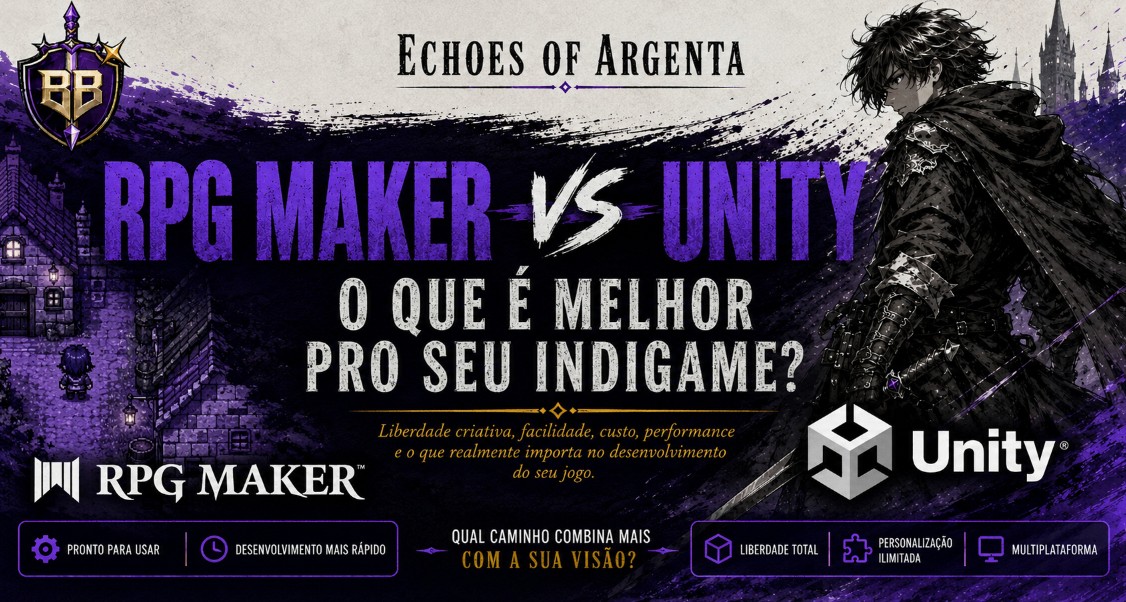
RPG Maker vs Unity explained through the development choices behind Echoes of Argenta.
Suggested Slug:
rpg-maker-vs-unity-indie-rpg-echoes-of-argenta
Image Alt Text:
RPG Maker vs Unity indie RPG development comparison for Echoes of Argenta
Suggested Category:
Game Development
Focus Keyword:
RPG Maker vs Unity
“`html
RPG Maker vs Unity: What Fits an Indie RPG Like Echoes of Argenta?
The RPG Maker vs Unity question is not really about which engine is “better.” It is about what kind of game you are trying to build, how much control you need, how fast you want to move, and whether your project can survive the extra work that comes with creative freedom.
For an indie RPG like Echoes of Argenta, that question matters because large parts of the mechanics are already taking shape, while the art direction is still being debated. The team wants to honor classic RPG influences, but not simply imitate them. The harder goal is to bring in a more personal visual identity: a sense of Brazilian creativity, childhood drawing habits, and different artistic fingerprints shaped by old influences without being trapped by them.
Affiliate disclosure: this article does not currently contain affiliate links. If affiliate links are added later, Broken Build Games may earn a small commission at no extra cost to you.
Quick Answer: RPG Maker vs Unity for an Indie RPG
RPG Maker is usually better when the project is close to a traditional JRPG structure: tile maps, event-driven storytelling, menu-based progression, classic encounters, and a familiar production pipeline. Unity is usually better when the game needs custom mechanics, unusual presentation, flexible animation, a more personal art style, or systems that do not fit neatly inside a classic RPG template.
So the practical answer is simple:
- Choose RPG Maker if speed, structure, and classic RPG conventions are the priority.
- Choose Unity if identity, custom systems, and long-term flexibility are the priority.
- For Echoes of Argenta, Unity feels like the stronger fit if the team truly wants the game to look and behave like its own thing.
Why RPG Maker Is Still Tempting for Indie Developers
RPG Maker exists because many developers do not want to spend months building the basic language of an RPG before they can even test the story. It gives you a recognizable structure from the beginning: maps, events, characters, database entries, combat logic, items, skills, animations, and progression tools.
That is not a small advantage. For a small indie team, the fastest engine is often the one that lets you finish scenes, test pacing, and see the emotional rhythm of the game earlier.
RPG Maker rewards clear RPG structure
RPG Maker is strong when the game already wants to speak in the language of classic RPGs. Towns, dungeons, dialogue events, treasure chests, character stats, scripted sequences, and turn-based combat all feel native to its workflow.
That matters because production is not only about power. It is also about momentum. When the tool already understands the genre, the team spends less energy reinventing basic systems and more energy writing quests, balancing progression, building maps, and testing the player journey.
The trade-off: the engine has a strong fingerprint
The problem is not that RPG Maker is weak. The problem is that it is opinionated. Its default assumptions are very visible unless a team works hard to customize them.
That “RPG Maker feel” can show up in movement, menus, battle presentation, map proportions, UI behavior, and event pacing. Some players love that familiarity. Others immediately read it as a limitation, even when the game has strong writing or interesting ideas.
Why Unity Gives an Indie RPG More Room to Become Strange
Unity is not automatically better than RPG Maker. It is simply wider. It gives the team more space to define how the game moves, animates, transitions, displays UI, handles combat, uses lighting, presents dialogue, and mixes 2D art with effects or camera behavior.
That freedom is powerful for a project like Echoes of Argenta because the team is not only asking, “How do we make an RPG?” The harder question is, “How do we make this RPG feel like it came from us?”
Unity helps when art direction is part of the game’s identity
If the art style is still undecided, Unity gives more room to experiment. The team can test hand-drawn sprites, painted backgrounds, unusual proportions, custom UI, animated portraits, non-standard camera framing, lighting effects, and transitions that would feel less natural inside a stricter RPG template.
This becomes especially important when the goal is not just “retro.” Retro can become a costume very quickly. A personal art style needs room for imperfection, exaggeration, cultural memory, and the kind of visual choices that do not always fit inside default tilesets.
The trade-off: Unity makes you earn the basics
Unity gives more control, but it also asks more from the team. Menus, dialogue systems, save systems, interactable objects, battle logic, inventory behavior, camera rules, and scene transitions may need to be built, adapted, or integrated more carefully.
This is where many indie projects get into trouble. They choose the flexible engine because the dream is bigger, but then spend too much time building infrastructure and not enough time finishing the game.
RPG Maker vs Unity: The Practical Comparison
| Category | RPG Maker | Unity |
|---|---|---|
| Best use case | Classic RPGs with familiar structure | Custom indie games with flexible systems |
| Speed | Faster for traditional RPG workflows | Slower at first, stronger for custom pipelines |
| Art direction | Works well with tile-based and classic layouts | More flexible for hand-drawn, hybrid, or unusual styles |
| Mechanics | Great when systems follow RPG conventions | Better when the systems need to be original |
| Risk | The game may feel too familiar if not customized | The project may grow too complex without discipline |
| Best mindset | “Let’s finish a strong RPG efficiently.” | “Let’s build the exact RPG this project needs.” |
How This Applies to Echoes of Argenta
Echoes of Argenta sounds like the kind of project where the engine decision is also a creative decision. The mechanics are already moving forward, but the visual identity is still open. That means the team is not only choosing a tool. It is choosing how much friction it is willing to accept to protect the personality of the game.
The important detail is the desire to honor classic influences without being swallowed by them. Many indie RPGs say they are inspired by old games. The more interesting question is what they do after that inspiration is visible.
A classic influence should give the player a point of emotional recognition. It should not become a cage that prevents the game from developing its own accent.
That is where the idea of “Brazilian identity” becomes more than a visual label. It can influence rhythm, color, body language, architecture, humor, character silhouettes, environmental details, menu personality, and even how the world feels lived in.
The Common Misunderstanding About RPG Maker vs Unity
The common misunderstanding is that RPG Maker is for beginners and Unity is for “serious” developers. That is too simple.
A focused RPG Maker project can be more complete, more coherent, and more emotionally effective than an overbuilt Unity project that never finds its shape. At the same time, Unity can be the better choice when the project needs to escape a template and create a stronger signature.
The real question is not prestige. It is fit.
- Does the engine support the strongest version of the game?
- Can the team handle the technical cost of that choice?
- Will the tool help the game become more specific, or just more complicated?
Why Art Direction Changes the Engine Debate
If Echoes of Argenta used a fully traditional RPG visual language, RPG Maker would be a very natural candidate. But the moment the team says, “We want our childhood drawings, our own influences, our own Brazilian touch, and our own separate styles inside the game,” the conversation shifts.
That kind of goal may demand more than asset replacement. It may require different animation timing, custom proportions, non-standard menus, expressive transitions, and scenes that are arranged around emotion rather than default map logic.
A personal style is harder, but it ages better
A borrowed style can look clean very quickly. A personal style often looks messy before it becomes coherent. That middle stage is uncomfortable, especially in a devlog, because the team can see the gap between intention and execution.
But that is also where a game can begin to separate itself. The sketches, imperfections, handmade silhouettes, and strange little decisions are often the things players remember after they forget the exact stat curve or quest reward.
The Broken Build Perspective: Tools Should Protect the Game’s Soul
The most useful way to think about RPG Maker vs Unity is not “easy versus hard.” It is “structure versus authorship.”
RPG Maker protects structure. It keeps the team close to the shape of a classic RPG and reduces the number of blank-page decisions. That can be a gift when the goal is to finish a strong, focused, familiar game.
Unity protects authorship. It allows the team to ask stranger questions: What should a menu feel like in this world? How should a scene transition breathe? Should a character move like a classic sprite, a sketchbook drawing, or something between the two? What if the combat system needs a rhythm the default RPG format does not expect?
For Echoes of Argenta, the decision should be made by identifying which part of the game cannot be compromised. If the non-negotiable part is finishing quickly inside a classic RPG structure, RPG Maker has a strong case. If the non-negotiable part is building a game with a distinct visual and mechanical identity, Unity becomes harder to ignore.
A Better Decision Framework for Small Indie Teams
Instead of asking which engine is better, a small team should answer five practical questions:
- What systems are already working? Do not restart the project just because another engine feels more attractive.
- What visual ideas are impossible or painful in the current tool? If the art direction needs unusual presentation, test it early.
- What does the game need to feel like in the player’s hands? Movement, pacing, combat, and menus matter as much as screenshots.
- How much technical debt can the team survive? Freedom is only useful if the project can still be finished.
- What will make the game recognizable? If the answer is “our voice, our art, our rhythm,” the tool must support that identity.
The best test is not a long debate. It is a small vertical slice. Build one room, one dialogue scene, one combat interaction, one menu, and one emotional visual moment. Then compare how each engine handles the same piece of the game.
So, Should Echoes of Argenta Use RPG Maker or Unity?
Based on the current direction, Unity seems like the better long-term fit for Echoes of Argenta, especially if the team wants the final game to carry a more personal art style and avoid feeling locked into a recognizable RPG template.
That does not make RPG Maker a bad choice. It means RPG Maker is strongest when the game’s identity lives mainly in writing, progression, map design, and classic RPG rhythm. Unity becomes stronger when the identity also lives in the presentation layer: animation, camera, effects, interface, visual language, and custom systems.
For a project trying to mix classic influence with Brazilian personality and personal drawing styles, the extra work may be part of the point. Not because suffering through production is noble, but because some ideas need room before they can become visible.
FAQ
Is RPG Maker good enough for a serious indie RPG?
Yes. RPG Maker can absolutely support serious indie RPG development, especially when the game fits a classic structure. The limitation is not seriousness; it is how much the project needs to move beyond the engine’s default assumptions.
Is Unity too hard for a first indie game?
Unity can be difficult if the team tries to build everything at once. It becomes more manageable when the scope is controlled, systems are prototyped early, and the team focuses on the mechanics that truly define the game.
Which engine is better for custom art?
Unity usually gives more flexibility for custom art direction, especially if the game needs unusual animation, camera behavior, UI, effects, or scene composition. RPG Maker can use custom art too, but its structure may shape how that art is presented.
Should an indie team switch engines mid-development?
Only if the current engine is blocking core features or the project’s identity. Switching engines can reset momentum, so the team should test a small vertical slice before making a full commitment.
What is the safest choice for Echoes of Argenta?
The safest production choice may be RPG Maker if the team wants a classic RPG pipeline. The stronger creative choice may be Unity if the team wants Echoes of Argenta to have a more distinct visual and mechanical identity.
What This Reveals About Indie RPG Development
The engine does not make the game meaningful by itself. It only changes which problems the team will face every week.
RPG Maker asks, “Can you make something memorable inside a familiar structure?” Unity asks, “Can you control your ambition enough to finish something personal?” Both questions are hard. Both can lead to good games. But they lead to different kinds of work.
For Echoes of Argenta, the most interesting path is the one that protects the team’s personal voice. If that means choosing the more demanding tool so the game can carry its own art, its own rhythm, and its own cultural fingerprints, then the extra work may not be a detour. It may be the thing that makes the game worth building.
“`